Inside Holy Fire® Reiki Master Training
“Guide me and heal me so I can be of service to myself and others.”
When I arrived in Glastonbury, I was excited to deepen my Reiki practice and learn directly from William Lee Rand. I expected to gain new knowledge and a deeper understanding of Holy Fire® Reiki. What I did not expect was how fully the training would invite me to continue my own healing journey.
Although I had already completed Reiki I and Reiki II, this experience felt different from the very beginning. It was not simply about learning more, receiving another certification, or adding a new title to my work. It was an invitation to become quieter, more present, and more receptive—to trust that the experience each of us needed could unfold without being forced.
That simple opening prayer captured exactly why I had come. Like the practices that have shaped my life—mindfulness meditation, sound healing, breathwork, and Reiki—I was not seeking perfection. I was seeking continued growth, deeper healing, and a greater capacity to be of service.
The Practitioner Is Not the Healer
One of the first teachings that resonated with me challenged the way many people think about healing. In Holy Fire® Reiki, the practitioner is not the one doing the healing. The energy of Holy Fire® Reiki is understood to guide the process, while the practitioner creates a safe and compassionate space in which the recipient can receive.
I found that perspective incredibly freeing. It removed the pressure to “fix” anyone or to decide what another person needs. The practitioner does not have to control the experience. Our role is to be present, grounded, and open—to trust that healing can occur in its own time and in the way that is most appropriate for each person.
This philosophy felt beautifully familiar. When I facilitate a sound bath or guide a mindfulness meditation, I do not believe that I am healing someone. I am creating conditions that may help a person slow down, feel safe, reconnect with themselves, and become more available to their own inner wisdom. The modalities may be different, but the intention is much the same: less directing, more listening; less striving, more receiving.
The Healing River of Life
One of our earliest experiences was the Healing River of Life. Without reproducing the meditation itself, what stayed with me most was the symbolism of water—not only as something that sustains life, but as a gentle force of movement, cleansing, renewal, and trust.
A river does not question every turn or struggle to hold on to where it has already been. It continues to move. It finds its way around obstacles, changes course when necessary, and remains part of something larger than itself.
The experience reminded me that healing does not always require us to analyze every wound or consciously revisit every painful memory. Sometimes healing happens quietly, beneath the surface, in ways we may not immediately understand. There can be wisdom in allowing the process to unfold without demanding an explanation.
That is not always easy. Most of us want to know what is happening, why it is happening, and when we will feel different. Yet the river offered another possibility: we can loosen our grip, trust the current, and allow ourselves to receive what is ready to come.

Healing the Ego and Returning to the Present
Another teaching that stayed with me centered on the ego. We explored the difference between a healthy ego—which helps us function, make choices, and move through the world—and an unhealthy ego that can keep us trapped in regret about the past or fear about the future.
As someone who has spent the past several years immersed in mindfulness meditation, I could not help but notice how closely this aligned with the practice of returning to the present moment. The past matters, and the future deserves thoughtful attention, but neither is where life is actually happening.
Different traditions. Different language. The same timeless truth: be here now.
Mindfulness has taught me that being present does not mean denying what has happened or pretending we never worry about what lies ahead. It means noticing when the mind has carried us away and gently returning—to the breath, to the body, and to the life that is here. Hearing this truth echoed within the Reiki training felt like another reminder that authentic healing traditions often meet in the same place.
Receiving the Four Ignitions
Over the three days, we received four Ignitions. In Holy Fire® Reiki Master training, Ignitions are part of the process through which the student is connected more deeply with the Master energy. Earlier levels use Placements; at the Master level, the process is called an Ignition.
What was striking was how little the experience asked us to do. There was no need to perform, strive, visualize something perfectly, or manufacture a particular feeling. We were invited to settle into a receptive state and allow the experience to be guided by the Holy Fire® energy.
That simplicity can be challenging. We are so accustomed to measuring progress through action and accomplishment. Yet each Ignition reminded me that some of our most meaningful inner shifts do not come from working harder. They come when we become quiet enough to receive.
No two people necessarily experience an Ignition in the same way. Some may notice warmth, color, imagery, or a sense of energy moving. Others may simply feel calm. Still others may not recognize the full effect until later. I appreciated that there was no hierarchy of experience—nothing dramatic had to happen for the process to be meaningful.
The Holy Love Experiences
The Holy Love Experiences deepened this lesson of trust. Each was intended to meet the participant where they were and offer the kind of healing or support that was most appropriate at that moment. Rather than directing the energy toward an outcome we had chosen, we were asked to become receptive and allow the experience to unfold.
At its heart, Holy Love invited us to experience love as something more expansive than an emotion exchanged between people. It was presented as a nurturing spiritual presence—one that can soothe, support, and help us feel safe enough to release what no longer serves us.
Some of the Holy Love work was described as reaching beyond the conscious mind and touching earlier layers of experience. We did not have to identify every memory or understand exactly what was being healed. Sometimes the experience is simply calm, stillness, or the quiet sense of being held, with its meaning revealing itself later. Once again, the teaching was to release expectations and trust what was happening beneath the surface.
Healing Ourselves Before Serving Others
A theme running through the entire weekend was the importance of tending to our own healing. The prayer we began with did not say only, “Help me heal others.” It began with “Guide me and heal me.” Those words placed personal healing not in opposition to service, but at its foundation.
That distinction matters. In every healing profession, it can be tempting to focus outward—to become so dedicated to helping others that we neglect the places within ourselves that still need attention. But we cannot offer presence if we are never present with ourselves. We cannot create safety for others while ignoring our own need for rest, reflection, honesty, and care.
I have spent years in therapy and in practices including meditation, breathwork, sound healing, and Reiki. Those experiences have changed my life. Yet I have also learned that healing has layers. Reaching one layer does not mean the journey is finished. Sometimes a new season of life gently reveals something else that is ready to be understood or released.
That realization did not feel discouraging. It felt hopeful. We do not have to be perfectly healed before we can serve. We simply need the willingness to keep doing our own work—with humility, compassion, and honesty.
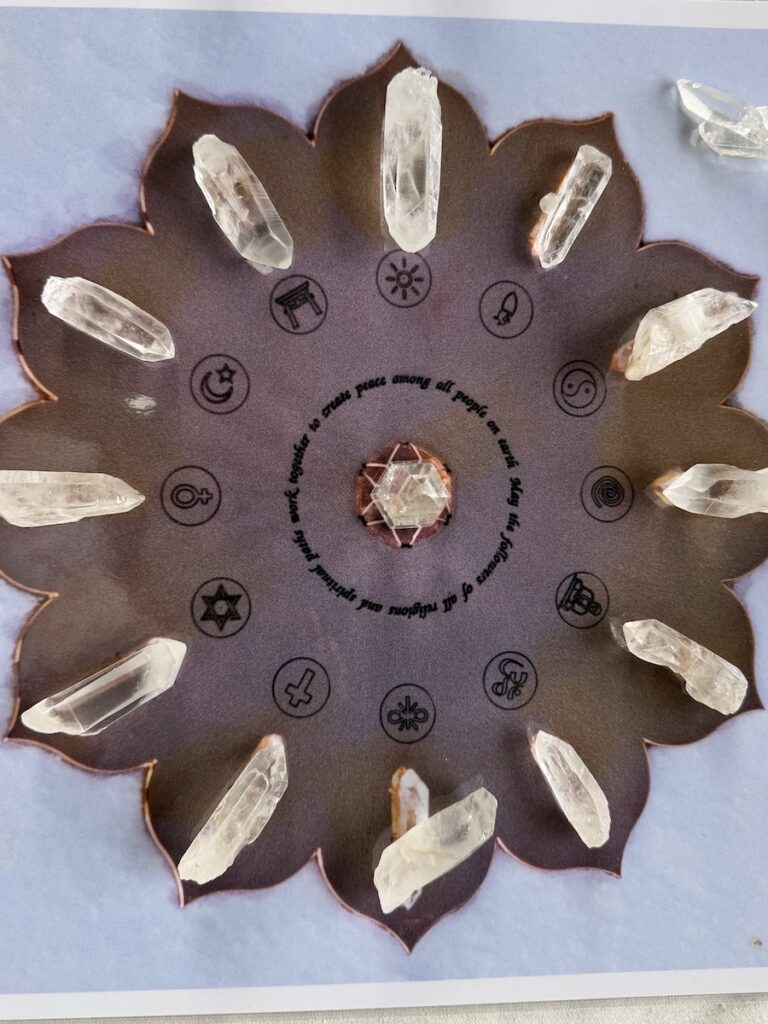
The World Peace Crystal Grid
The World Peace Crystal Grid added a wider dimension to the training. In Part One, I shared William’s extraordinary journey to place a grid at the South Pole. During the training, the meaning behind the project became even clearer.
The grids were created to support peace among people of different religions and spiritual paths. Their message is simple but demanding: peace does not require sameness. It asks us to honor one another and work together beyond our differences.
I was moved by the idea that spiritual practice is not only personal. The peace we cultivate within ourselves affects how we speak, listen, respond, and move through the world. Inner healing does not solve every global problem, but it can change the way we participate in the world around us.
For me, the grid represented intention made visible. Each crystal, each prayer, and each person holding a vision of peace becomes part of a larger field of possibility. It was a reminder that even when the world feels divided, the desire for peace remains something we can choose to nourish.
The Twelve Heavens
The Twelve Heavens experience was among the most expansive parts of the training. Rather than attempting to describe each heaven or define an experience that is deeply personal, what stayed with me was the sense of moving through successive layers of spiritual awareness.
The journey invited reflection on who we are beneath our roles, histories, accomplishments, and fears. It touched on purpose, authenticity, and the possibility that healing is not about constructing a new self, but remembering what has always been present beneath everything we have accumulated. Sometimes growth is less about becoming more and more about releasing identities, beliefs, and old stories that prevent us from living fully.
Perhaps transformation is not always about adding. Sometimes it is about remembering.
The Ocean of Holy Love
The Ocean of Holy Love offered another powerful image of surrender. It was described as an ocean of liquid light containing many colors and frequencies, with each person receiving the experience most suited to their needs.
I loved the image of being supported by something vast—floating rather than struggling, breathing rather than bracing, and allowing waves of light to move around and through us. Water appeared again as a teacher: a river moves us forward, while an ocean asks us to recognize how small our efforts to control everything really are. In both, there is an invitation to trust and allow ourselves, for a time, simply to be held.

The Heavenly Banquet Hall
The Heavenly Banquet Hall experience brought a different quality to the journey—one of spiritual nourishment. The image of gathering around a large table and receiving light offered a beautiful reminder that healing is not only about releasing pain. It is also about allowing ourselves to be replenished.
Many of us are much more comfortable giving than receiving. We know how to care for others, meet obligations, and continue moving even when we are depleted. The idea of a spiritual banquet asked something different: Can we sit at the table? Can we accept nourishment without proving that we deserve it? The question felt especially meaningful in a training centered on service. To serve from exhaustion is not sustainable; to serve from a place nourished by prayer, community, nature, stillness, and inner practice is something entirely different.
The End of the Training—and the Beginning
By the time we received the fourth Ignition and our three days together drew to a close, I understood that the training had never been only about becoming a Reiki Master. It had been about trust, presence, humility, and our willingness to remain students of our own lives.
I did not leave Glastonbury believing that I had arrived at a final destination. No authentic healing path offers that promise. I left with practices to deepen, experiences to integrate, and a renewed appreciation for the mystery of how healing unfolds.
I did not leave Glastonbury feeling like someone new. I left feeling more like myself.
Perhaps that was the greatest gift of the training. Healing is not about fixing what is wrong with us or becoming someone entirely different. It is about gently releasing what no longer serves us so we can live more fully as who we already are.
The experiences of those three days—the prayer, the river, the Ignitions, Holy Love, the World Peace Crystal Grid, the Twelve Heavens, the Ocean of Holy Love, and the Heavenly Banquet Hall—were not separate lessons. Together, they carried one message: healing asks for our participation, but it does not ask us to control every step. The more I continue to heal within myself, the more fully I can be of service to others. Yet becoming a Reiki Master does not mean that I have the personal power to heal another person. Through the Ignitions, I received the ability to work with Reiki Master energy. That energy is transmitted through me; I am the channel, not the source. My role is to show up with sincerity, create the conditions for healing, and then trust what unfolds.
The class had ended, but the deeper journey was just beginning.
Coming Next: Part Three—Transformation
In Part Three, I will share how I am integrating Holy Fire® Reiki into my daily life and work, how it complements mindfulness meditation, sound healing, and breathwork, and why our deepest learning often begins after we leave the classroom.